


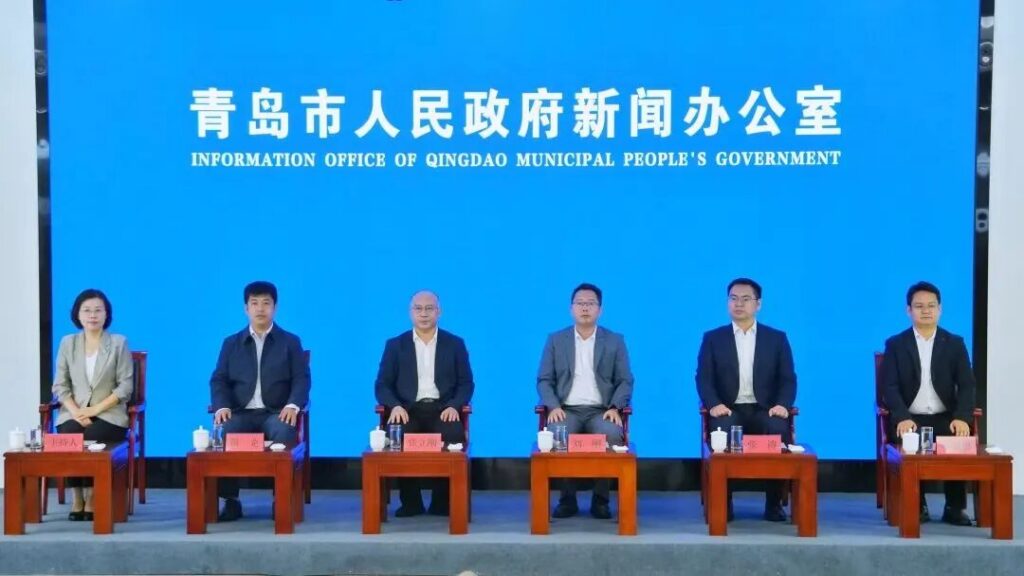
On August 28, the Information Office of the Qingdao Municipal Government held the fifth session of the Qingdao series of on-site media briefings under the ‘Shandong Good Brands on the Industrial Chain’ initiative – a special session on the green-energy industry chain. Ju Long, Deputy Director of the Industry and Market Development Center of Dongfang Wind Power and General Manager of Dongfang Wind Power (Qingdao) New Energy Co., Ltd.; Zhang Ligang, Chairman of Qingdao Hanhe Cable Co., Ltd.; Liu Gang, General Manager of Guangzhou Great Power Energy (Qingdao) Co., Ltd.; Zhang Tao, Chairman of North Star Advanced Circular Technology (Qingdao) Co., Ltd.; and Li Rongzhong, General Manager of Qingdao Leice Innovation Technology Co., Ltd., attended the briefing and answered reporters’ questions.
North Star Advanced Circular Technology (Qingdao) Co., Ltd.
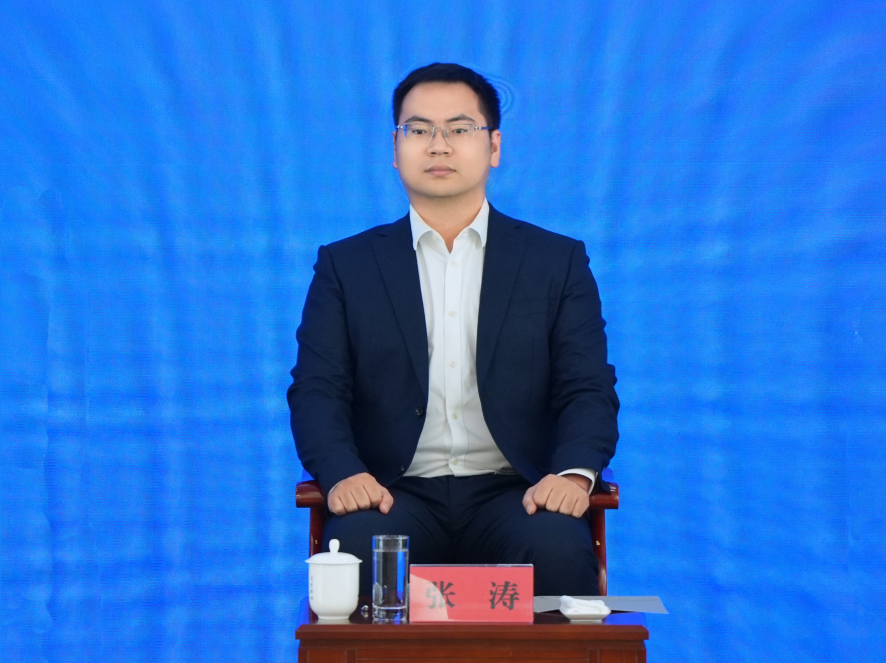
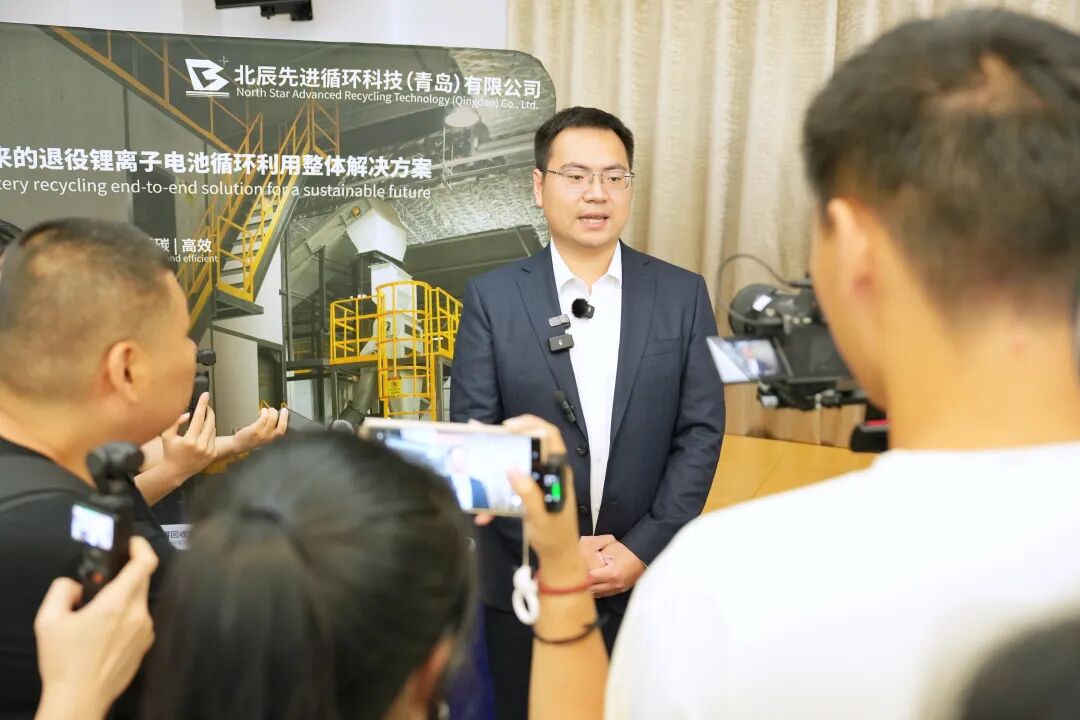
Founded in August 2020 and headquartered in Chengyang District, Qingdao, North Star Advanced Circular Technology (Qingdao) Co., Ltd. is an innovative technology enterprise dedicated to providing low-carbon, green circular-utilization overall solutions for emerging-industry waste such as retired lithium-ion batteries, photovoltaic modules, wind-turbine units, and fuel cells.
As a global technology leader in the circular utilization of retired power batteries, North Star Recycling provides end-to-end overall solutions covering battery collection, transport, dismantling, regeneration, and material recovery. By delivering green recycling processes, intelligent equipment systems, and low-carbon recycled materials, we help our customers build advanced battery-recycling and treatment bases, establish a sustainable supply system for key battery materials, and contribute a distinctive ‘China solution’ to the global low-carbon transition.
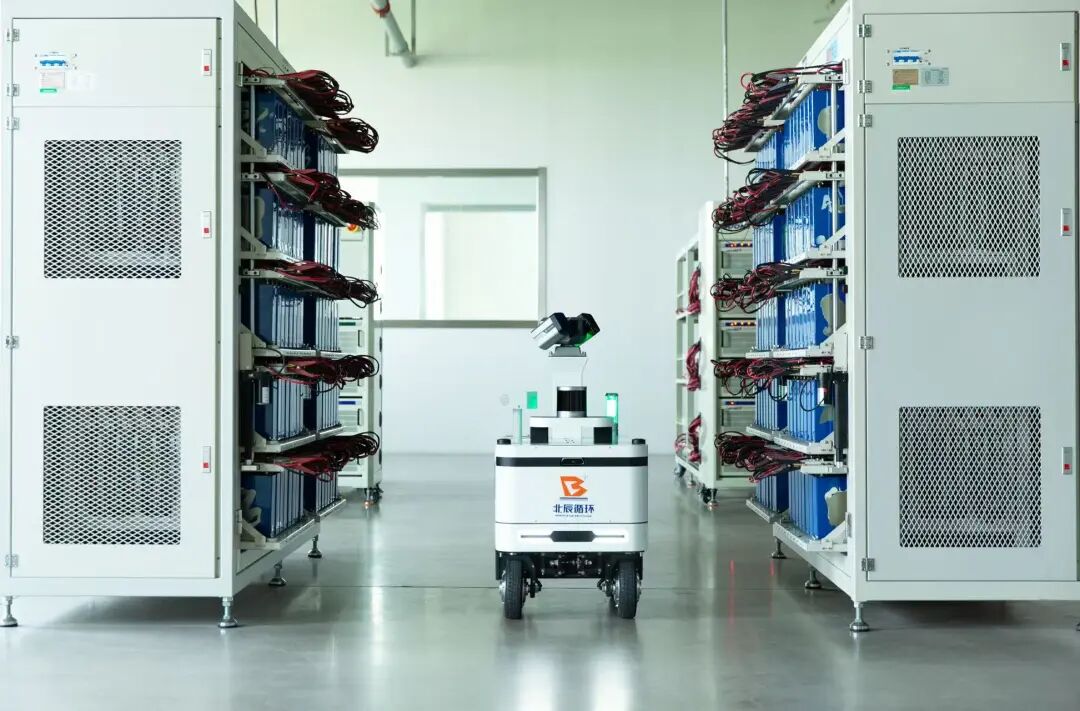
The company has been recognized through multiple designations, including the ‘Qingdao Retired Power Battery Low-Carbon Circular-Utilization Innovative Application Laboratory,’ ‘Qingdao Innovative SME,’ ‘Qingdao New-Economy Potential Enterprise,’ and ‘Specialized, Sophisticated, Differentiated, and Innovative SME,’ and has been successfully listed by the Ministry of Industry and Information Technology (MIIT) among enterprises that meet the ‘Industry Specification Conditions for the Comprehensive Utilization of Used Traction Batteries from New Energy Vehicles.’
We place great emphasis on technology R&D and industry-academia-research collaborative innovation, maintaining long-term, in-depth cooperation with renowned universities such as Tsinghua University, China University of Mining and Technology, and Beijing Institute of Technology. Integrating R&D, design, production, and operation, our production base is committed to the innovation and deployment of advanced recycling technologies, providing customers with overall solutions spanning resource utilization and carbon-footprint management.
In August 2024, the Qingdao demonstration project – with an annual processing capacity of 10,000 tonnes of retired power batteries for regeneration and 30,000 tonnes for cascaded utilization – was fully completed and put into operation. As the new-energy industry continues its rapid growth, the volume of retired batteries is rising year by year. Battery circular utilization has become a key link connecting the ‘Two New’ strategy with the circular-economy system, with enormous market potential and rapidly emerging as a new growth driver for the green-energy industry.
Meanwhile, we have completed the digital upgrade and technological innovation of the North Star Advanced Circular Technology demonstration project, achieving safe, standardized, efficient, and low-carbon treatment of retired power batteries, with fully traceable carbon footprints throughout and overall carbon emissions 30% lower than the industry average.
Looking ahead, we will actively respond to the ‘Action Plan for Improving the Recycling and Utilization System for New-Energy Vehicle Power Batteries’ issued by the General Office of the State Council, and join hands with authoritative institutions such as Siemens (China), the Solid Waste Management Center of the Ministry of Ecology and Environment, and Tsinghua University to jointly build a battery-recycling and recovery system based on the ‘Qingdao model.’ We will focus on developing data assets and carbon assets in the recycling process, and drive the replication and scale-up of this model nationwide, continuously injecting new momentum into the global green-energy transition.
Journalist Interview
China News Service reporter: We understand that North Star Recycling is in deep cooperation with Siemens, exploring digital-intelligent and energy-carbon management in the resource-recycling field. Could you elaborate on how the two sides are using AI and digital technologies to drive the transformation and upgrading of the battery-recycling industry, and what new value this creates for North Star and its customers?
Zhang Tao: Our cooperation with Siemens is not merely a technical collaboration for North Star Recycling; it is a core strategy through which we are driving the upgrade of the resource-recycling industry toward digital-intelligent and low-carbon development. I will address this from three aspects.
First, we jointly built a digital foundation for ‘smart energy-carbon management.’
Relying on the Siemens SiTANJI carbon-footprint ecosystem solution, we jointly built the first blockchain-based real-time carbon-footprint accounting and traceability system in China’s battery-recycling industry. In short, through IoT and edge-computing technologies, we collect in real time the energy-consumption, material-flow, and recycling-process data from the production line, then integrate authoritative domestic and international carbon-emission factor databases to build a high-precision carbon-accounting model – a model that has been certified by TUV SUD. This means that for every retired battery, the entire process from recycling to regeneration can be computed in real time, recorded dynamically, and stored on-chain with tamper-proof data. This not only provides a scientific basis for our own emission-reduction production, but more importantly gives downstream customers credible low-carbon data credentials, helping them meet international requirements such as the EU New Battery Regulation and smoothly access global markets.
Second, AI and intelligent technologies are fundamentally transforming the operating model of battery recycling.
Within this system, artificial intelligence runs through the entire process of safety identification, intelligent dismantling, material separation, and process optimization: through AI vision recognition, the system can automatically determine battery model, state of health, and even degree of damage, and automatically match the optimal dismantling plan, greatly improving safety and recycling efficiency; through digital-twin technology, we simulate and optimize the operation of the entire plant in a virtual space, identifying bottlenecks early and reducing trial-and-error costs; more importantly, based on machine learning, the system can dynamically optimize process parameters in physical separation, improving the separation and recovery efficiency of all components of retired power batteries, achieving ‘full-value extraction’ and high-value utilization – and it is now being gradually extended to hydrometallurgical processes. In this way, we have upgraded traditional ‘experience-driven’ recycling into a data-driven, intelligently-decided modern circular factory.
Third, all of this ultimately translates into threefold value created for our customers and for ourselves.
Low-carbon value: certified carbon reductions may in future become carbon assets tradable in the carbon market, bringing customers economic returns in addition to environmental benefits;
Trust value: tamper-proof full-lifecycle carbon-traceability data provides battery-recycled materials with an internationally recognized ‘green passport,’ becoming a hard requirement for automakers and battery manufacturers in building green supply chains;
Efficiency value: the intelligent system lowers overall recycling costs and improves efficiency, ultimately providing customers with more stable and price-competitive recycled materials, easing upstream resource pressure.
In summary, our cooperation with Siemens is not about simply retrofitting a single production line, but about jointly defining a new standard for green battery circularity. North Star Recycling’s positioning is also evolving from a technology-based recycling enterprise into ‘a provider of green circular-system solutions and an exporter of standards.’ We also look forward to scaling the ‘digital-intelligent low-carbon circular’ model proven in Qingdao across the country to empower the entire industry, and in the future extending it to more emerging-industry waste streams such as photovoltaics and wind power, contributing Chinese wisdom and Chinese strength to the global development of ‘zero-waste cities’ and the circular economy.
This article is reprinted from the Qingdao Release official account.